
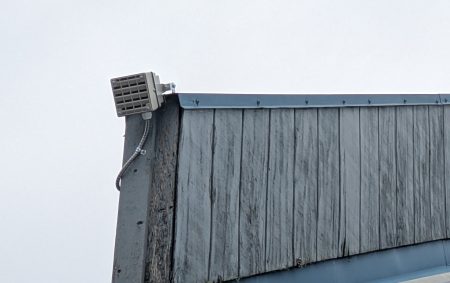
Homeless advocates and police say an illegal noisemaking device was used against unhoused campers in downtown Astoria in early May.
The incident comes after efforts to establish an official campsite stalled and as city leaders are set to continue discussions about how to address concerns and issues tied to Astoria’s most visible homeless residents.
On May 6 and 7, homeless advocates and others reported high pitched pinging and ringing noises coming from two devices installed at a Wilcox & Flegel Oil Company location at 5th Street and Marine Drive near the Chevron gas station.
Astoria police say the noise was first reported as a malfunctioning alarm that Wednesday. When noise complaints continued the next day, an officer visited the site in person. The company was told to turn off the devices or face legal consequences.
Wilcox & Flegel complied. Company representatives were not available for comment ahead of KMUN’s deadline.
Advocates described the noisemakers as “anti-loitering devices” intended to target nearby homeless campers. They said such an approach has no place in the city. Astoria Police Chief Stacy Kelly agreed.
“There’s no doubt that’s who they were targeting,” he told KMUN. “It’s definitely not a humane way to go about it.”
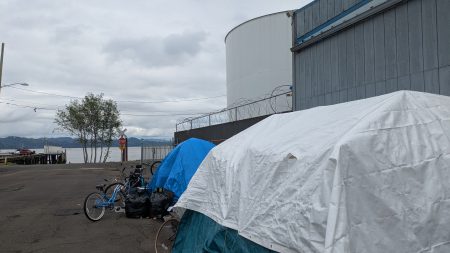
The 5th and 6th Street locations are among the few places unhoused people are allowed to camp under the city’s current camping ordinance. A handful of tents are clustered at the base of 6th street and there are often more on 5th Street, on the other side of the Wilcox & Flegel building.
Chris Crone, who has been unhoused for much of his life and has lived in Astoria for the past twenty years, is among the campers on 6th Street. He told KMUN he saw the devices being installed.
“I didn’t know what it was,” he said.
According to Crone, interactions between the 6th Street campers and employees at Wilcox & Flegel and the Chevron gas station have generally been friendly. He believed the noise devices were installed more in response to campers on 5th Street.
One device was aimed toward the 6th Street campers. Another was placed above 5th Street. Brad Minder, also a 6th Street camper, said it wasn’t possible to tune out the noise because the tone changed.
“It was just annoying,” Minder said. “It was driving people nuts.”
But he and others stayed.
“I was here,” Minder said. “We have no place else to go.”
Kelly said Wilcox & Flegel initially claimed the noise devices were directional, but residents in nearby homes — including Ward 1 City Councilor Andy Davis, who lives three blocks away — reported being able to hear the noise.
That conflicted with Wilcox & Flegel’s claim, Kelly said, adding that the devices are a violation of the city’s noise ordinance.
Kelly said company representatives told police they had been dealing with ongoing vandalism and damage at the property that they connected to the homeless campers.
“We have trespassing laws in place,” Kelly said. “If (the company) is experiencing damage, they should let us know and put up cameras and if we see the people doing it, we can address it rather than harming people who may not be involved.”
Davis represents the 5th and 6th Street areas where both the campers and Wilcox & Flegel are located. He said it’s understandable that the company would feel frustrated about vandalism and property damage.
But: “The city is trying to come up with solutions that will respect the rights of everybody involved,” he said. “I know that’s taking more time than a lot of people would like, but I think that’s our responsibility to take care of that problem. And people can be frustrated with us. That’s understandable, but they shouldn’t be taking things into their own hands.”
Tensions around Astoria’s unhoused population have spiked frequently over the years.
Now there are plans to revisit Astoria’s camping ordinance and the current City Council, as well as city staff like Kelly and City Manager Scott Spence, have revived old discussions and possible approaches to issues tied to homelessness.
In April, city councilors discussed two possible campsites for a designated homeless camp, but faced significant pushback from nearby residents and advocates who said the sites were not appropriate. One proposed site was located in a parking lot where there were concerns about contamination; the other site was on property located near the roundabout leading onto the Youngs Bay Bridge.
City Councilor Andrea Mazzarella said a designated campsite was meant to address core issues around homelessness in the city, but that the pushback city councilors heard points to a lack of trust and heightened frustration. The city councilors concluded that without strong public support for the sites, they could not proceed.
The City Council is set to continue the discussion around homelessness-related issues and the city’s response at a meeting Monday night.