
ASTORIA, Ore. — When the tug and barge building company, Hyak Tongue Point, proposed an ambitious plan to develop a shipyard at long under-utilized industrial land east of Astoria, the North Coast was sold on the idea.
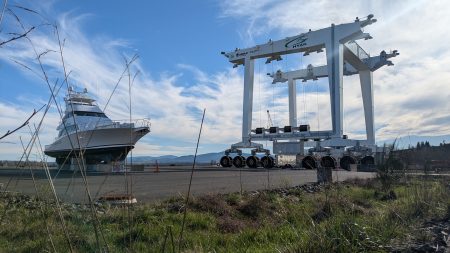
With the closures of other small and medium-sized boatyards in the region, Hyak’s shipyard at North Tongue Point was poised to fill an important gap. A key component would be a massive travel lift, the largest all-electric mobile travel hoist in the nation at that time, capable of lifting everything from commercial fishing boats to barges from the Columbia River.
Local leaders saw economic potential, a proposal that could strengthen and expand the regional maritime industry and a motivated landowner finally looking to do something with important industrial waterfront property. Vessel owners and operators saw a solution to shrinking options for boat repair work and inspections. Companies who would partner with Hyak to develop the shipyard and become anchor tenants at the site saw opportunities to expand their businesses.
The state of Oregon and governments in Clatsop County were convinced, too. Hyak’s boat lift project would end up landing around $21 million in state funding as well as a 15-year break on local property taxes.
In selling the idea to Oregon’s North Coast communities, Robert Dorn, a former co-owner of Hyak Tongue Point, predicted as many as 50 boats could be lifted, inspected and repaired within the first year of the lift being operational. He estimated that 100 new jobs would be created.
Now lawsuits brought by Hyak’s key tenants and partners in the shipyard project allege something very different has occurred.
In a complaint initially filed with the Clatsop County Circuit Court last year, WCT Marine & Construction claims the travel lift has only lifted two vessels since swinging into operation over a year ago: a barge named Beluga and a private yacht belonging to Hyak’s owner, Gordon Smith.
WCT also alleges that Hyak has broken contracts and agreements with WCT and is now charging such high rates that the lift and related shipyard services at North Tongue Point are not competitive with regional shipyards and out of reach for local boat owners.
WCT also alleges retaliation by Hyak, citing what it characterizes as unwarranted scrutiny of WCT’s operations, false invoices and more.
The company claims Hyak has interfered with WCT’s ability to use the property it is leasing from Hyak, claiming, “Hyak’s conduct is an anti-competitive attempt to drive WCT’s shipyard operations out of Tongue Point.”
WCT also alleges that concerns expressed about the condition of the lift have not been addressed.
Hyak, WCT claims in its lawsuit, is “not promoting what should be a mutually beneficial, long-term relationship intended to fulfill express commitments made to local and state authorities under grant and tax incentive agreements involving more than $21M in state funds.”
Another tenant, Bergerson Construction, has also filed against Hyak over alleged nonpayment of nearly $700,000 related to the construction of two piers and an upland asphalt deck at the shipyard.
As of March 10, that complaint for foreclosure of a construction lien was scheduled for a status check hearing in June at the Clatsop County Circuit Court. Bergerson and Hyak are also going through an arbitration process with the Arbitration Service of Portland.
Hyak had claimed the work by Bergerson was incomplete. Bergerson refuted this, noting that Hyak told the state the work was finished and the company received a final disbursement of state grant funds as a result.
In court filings responding to WCT’s complaint, Hyak has denied the substance and many details of the allegations, saying that “Hyak has honored all of its obligations under all referenced agreements.”
Hyak’s attorneys also pushed back on WCT’s claims about the condition of the lift, writing that the lift “was safe to operate at all relevant times…”
Hyak acknowledged alarms sounded when the barge Beluga was being lifted, but that “they were promptly cleared and did not prevent the successful operation of the lift.”
WCT representatives told KMUN they are not using the travel lift at all now. Instead, WCT is using a trailer to bring in boats for repairs and inspections. It is a more time and labor-intensive approach that requires a high tide and limits the size of the vessels that can be hauled out of the water.
Hyak representatives would not say if there is any current use of the lift by Hyak or others associated with Hyak.
John Hie, executive vice president of Hyak Maritime, declined to discuss the lawsuits with KMUN, saying those matters would run their course.
“The only thing I’ll say about the lawsuits is we did not bring the lawsuits and we’re not interested in pursuing lawsuits with people,” Hie said. “Any disagreements that are out there certainly have two sides to the argument.”
He said it is still Hyak’s goal to develop the shipyard facility.
Meanwhile, WCT owner Willie Toristoja said they plan to take the matter as far as they can —“until a judge or a jury makes a decision.”
“I think it’s really unfortunate and disappointing that it’s come to this, but at the same time we can’t be bullied,” he told KMUN. “We’re just trying to stand up for what this yard was built upon and the vision that Bob Dorn had for the yard and the promises made to the community and the marine community for the travel lift.”
Greg Morrill, owner of Bergerson Construction, isn’t sure how the shipyard and the business partnerships that aided its development move forward now.
“I would love for things to move forward in an atmosphere of partnering,” he said. “But I fear those opportunities are gone given the situation and just how things have devolved into legal disputes. It’s really tough to recover from that.”
But, like WCT, Bergerson felt it was important to file a lawsuit.
“We do a lot of work all around the region and we pride ourselves on doing what we say we’re going to do, doing what we’re contracted to do,” Morrill said. “And we expect to get paid when we’re done with the project. I don’t know why we can’t expect the same on this, especially with public money involved.”
For locals invested in the shipyard’s success but on the outside of the business partnerships, the situation is bewildering.
Kevin Leahy, executive director of Clatsop Economic Development Resources, worked with Hyak and WCT early on in the shipyard’s development.
He was present at meetings where Dorn pitched the idea of the shipyard and asked leaders for their support. He helped facilitate local and state requests and was a vocal champion of the project.
“There’s got to be a solution and I don’t know what it is,” he told KMUN.
“I’m just looking at … how much time we’ve all spent, like our team, the county, Business Oregon, all the partners in this initiative — and now having it kind of, let’s say, stuck,” he said. “How do we get it moving forward?”
‘A diamond in the rough’
Located about four miles from the heart of downtown Astoria, Tongue Point is a decommissioned Naval base. The peninsula that gives the area its name juts out into the Columbia River, a wedge of land that, indeed, looks like a tongue.
Today the area is home to several different facilities including the Tongue Point Job Corps Center and Clatsop Community College’s Marine and Environmental Research Training Station, or MERTS.
Hyak’s piece, the North Tongue Point site, sits at the end of a curving road below tree-covered hills. The site is dominated by the large hangars and buildings used by WCT and Bergerson and an expanse of tarmac terminating in piers and the river.
On a long stretch of tarmac, away from the hangars, the travel lift looms on four steel legs, each leg set with a collection of large wheels.
Unlike the trailer currently used by WCT, the lift places a sling under a vessel in the water, hoists it up and out and then wheels it to where it will be inspected or repaired. When in operation, the lift is meant to work quickly and efficiently. There are other such lifts on the Oregon Coast, but none capable of lifting vessels as large as what Hyak’s 1,500-ton lift can handle.
Before Hyak, previous visions and plans for North Tongue Point had faltered despite the site’s potential.
Beginning in 2009, the Port of Astoria leased the 30-plus acre property from Washington Real Estate Group, an investment company based in Montana. At various points, the port entered into discussions to purchase the property, but never finalized a deal.
In 2017, the port opted to end its 10-year lease two years early so the property could be sold to Hyak for $4.1 million.
Dirk Rohne was on the Port of Astoria commission when that sale happened. In 2018, he would refer to the sale during a commission meeting, calling it “a great win” for the community. He isn’t sure what to think now.
“I was very supportive and enthusiastic of the vision as Bob Dorn shared it, and the potential benefit to WCT Marine and Bergerson Construction, both of which are active economic contributors in our community,” he told KMUN.
Hyak Tongue Point is a subsidiary of Hyak Maritime, itself a subsidiary of Hyak Holdings Delaware LLC. The owner of all of this is Gordon Smith, who is also a majority owner of Hyak Motorsports, a stock car racing team with a car that competes in the NASCAR Cup Series races.
At the time that Hyak bought the North Tongue Point site, though, Robert Dorn was still a co-owner of Hyak Maritime. After the purchase and in the ramp up toward major funding requests to the state for the boat lift, Dorn was the face and voice of Hyak in Astoria.
Dorn called the North Tongue Point site a “diamond in the rough with respect to helping people maintain fleets.”
He pointed to the tighter federal regulations for boat inspections combined with shipyard closures in the Pacific Northwest. The lift Hyak wanted to bring to the North Coast would be a valuable local asset.
“We have many coastal tugs and barges, many big commercial fishing boats, but very limited options of places to go,” Dorn told The Astorian in 2021. “We’ve seen this coming over 20 years, and now it’s in crisis mode.”
When Hyak applied for nearly $14 million from the Oregon Department of Transportation’s Connect Oregon competitive grant program in 2021, Dorn collected numerous letters of support for the project from state politicians, from boat operators up and down the West Coast, from city councils and even from former state Senator Betsy Johnson.
To Hyak, public funding was critical — necessary, Dorn told The Astorian, to get the project off the ground but also to keep costs low for vessel owners.
“Without public support, I will never make a return on that,” Dorn told The Astorian, speaking about the investment in Tongue Point and the travel lift. “I would have to charge people enormous amounts of money to come in because these are expensive machines to maintain.”
Almost from the beginning, Hyak’s plans for North Tongue Point were well-received locally. But when Hyak went to the state in pursuit of public funding — for Connect Oregon funding specifically — the project encountered some resistance.