
State support
Connect Oregon grant funds are intended for non-highway transportation projects: rail, aviation and marine capital infrastructure.
In April 2022, a final review committee looked at 49 applications for $46 million in available funding. Among the applications was Hyak’s boat lift. All of the projects had already gone through a vetting process, evaluated and scored on their possible economic benefits and their consistency with regional economic priorities and related concerns in Oregon.
Now the final review committee would determine who ultimately made the cut for funding.
When the Hyak travel lift, also referred to as a mobile lift, came up for consideration, several committee members raised concerns.
They worried about the overall cost of the project as compared to the Connect Oregon funding available and the fact that the company’s request of more than $13 million would “use up a substantial portion of available funding,” according to minutes of the meeting. Some smaller projects from other entities might miss out on funding this round, they noted.
Hyak planned to match the Connect Oregon grant with $7 million the company had received from the Oregon Legislature. Given that Hyak was not bringing its own match to the Connect Oregon grant, some committee members said they were concerned that the project “would essentially be fully built from state funds.”
Committee members in favor of the lift project, though, echoed what other supporters had said.
They pointed to the possible number of direct and indirect jobs associated with the project and the need for the project “in how it would be the only facility in Oregon with this capacity and reduction in travel for boats needing repair.”
The Hyak project was ultimately ranked at number 16 out of 21 projects selected for funding.
Ranked at number 30 that year — and off the list for funding — was a request from the Port of Astoria for $7 million to rebuild the partially collapsed causeway at one of the port’s longstanding headaches, the East Mooring Basin. In 2024, that causeway would be removed entirely.
To receive the Connect Oregon money, Hyak entered into an agreement with the state that outlined how the money was to be used and the manner in which the project was supposed to proceed.
The agreement stated that funds might need to be returned to the state if the provisions in the agreement were not followed or if there were unspent funds or if the grant were terminated — standard language for Connect Oregon grant agreements and the closest thing to a clawback provision for the $13.9 million award to Hyak, according to a spokesperson for the Oregon Department of Transportation.
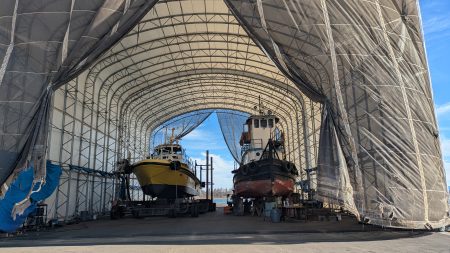
According to monthly reports Hyak submitted to the state, the boat lift components were shipped to Seattle beginning in February 2024 and arrived at North Tongue Point by early June 2024. The lift was assembled over that summer with commissioning and testing set for the fall.
A report to the state in September 2024, signed by Dorn, noted that the travel lift was up and running and had lifted a Tidewater Barges Line barge.
Early last January, a liaison with the Oregon Department of Transportation visited North Tongue Point. The liaison was given a tour of the work accomplished with the Connect Oregon funding and tasked with verifying that the work and infrastructure funded by the grant had been done.
The liaison saw the travel lift and other components and signed off on the inspection.
A second evaluation, referred to as the final report, is due to the state from Hyak by July 7 of this year.
In that report, Hyak will need to identify the number of jobs the company created or retained during the construction of the lift facility and after it was completed, among other details.
Local support
Besides the Connect Oregon money, Hyak’s travel lift project also benefited from a Clatsop Enterprise Zone abatement, giving the area a 15-year break on property taxes on redeveloped land WCT leased from Hyak — around $5.5 million in tax abatement, according to information available at the time the agreement was made.
WCT was the party named in the abatement agreement along with the sponsors of the Clatsop Enterprise Zone. These included Clatsop County, the cities of Astoria and Warrenton and the Port of Astoria.
In return for the tax breaks, WCT committed to a minimum investment in the facility — the $21 million toward the travel lift counted there.
At the time of the abatement agreement, WCT employed around 22 employees annually. Under the agreement, the company committed to hiring 50 additional employees and, after that, maintaining up to at least 72 full-time employees during the tax exemption period. After the facility was placed into service, WCT would have three years to accomplish the hires.
WCT also agreed to pay these employees high wages — equal or greater than 130% of the Clatsop County average annual wage.
At the Oct. 26, 2022 meeting where the Clatsop County Board of Commissioners unanimously signed off on the agreement, Commissioner Lianne Thompson thanked Dorn, who was in the audience, and Commissioner Pamela Wev called the shipyard project “the most exciting, to my mind, economic development area of Clatsop County right now.”
But in a document signed July 1, 2025, WCT transferred that abatement agreement over to Hyak along with the obligations to grow jobs and provide high wages.
WCT filed its lawsuit against Hyak in the Clatsop County Circuit Court several months later.
Hie confirmed that Dorn is no longer associated with Hyak. KMUN’s calls to Dorn for comment on this story were not returned. KMUN also reached out to Betsy Johnson, who declined to be interviewed.
Representatives with Business Oregon, the state’s economic development agency, were also key advocates and facilitators for the project. In 2018, the agency helped Hyak secure a $350,000 grant from the Governor’s Strategic Reserve Fund to rehabilitate a seaplane ramp at North Tongue Point and increase its load capacity.
In 2023, Dorn wrote a letter of support on behalf of Business Oregon’s budget request to the Legislature’s Joint Ways and Means Committee and referenced the 2018 grant. He noted that Hyak was required under that grant to invest $5 million into the businesses at Tongue Point within the next five years. Hyak ended up investing $8.2 million by the end of year four, he said.
Dorn took the opportunity to emphasize the importance of Hyak’s North Tongue Point facility to generate new jobs in the maritime industry and the support the shipyard would provide for the “critically important Columbia River towboat and barge fleet.”
Business Oregon representatives declined to be interviewed for this article.
In an email, a spokesperson wrote, “Our only comment would be that we would love to see Tongue Point rise to its potential as a tremendous asset to the region and the economic driver that was first envisioned by Hyak and its partners.”
‘That is the best area’
On a sunny day in February, WCT had several vessels staged for repairs at North Tongue Point. Tugs owned by Toristoja rested along a pier.
Farther down was a 110-foot vessel, Western Dawn, used in the Pacific whiting fishery. It was in need of the routine inspection and repair work that people in the industry refer to as “a cut and shave,” but was too large to be hauled out by WCT’s trailer.
Owner Burt Parker later received a quote from Hyak for the work and the use of the travel lift. It was nearly four times more than what he had expected to pay.
Now, he has an appointment with a shipyard in Seattle. Even accounting for additional fuel and crew costs to get Western Dawn there, Parker expects he’ll pay less than what Hyak would have charged.
Parker has boats based out of Washington state and Alaska and several, like Western Dawn, out of Astoria.
He grew up on boats. He started fishing with his father as a child and bought his own boat as a young adult. He’s seen the industry change and the path to entry become increasingly difficult for the next generation of fishermen.
Several years ago, he bought a boat in San Diego and stopped along ports all the way up the coast. In his opinion, Astoria was one of the worst places to bring a boat and still is.
One reason Western Dawn was sitting at North Tongue Point was because there was nowhere with the Port of Astoria where it could be tied up and the Warrenton marina was full, Parker said.
For the vessel operators and owners who were looking forward to the shipyard facilities Hyak had planned, the current situation at North Tongue Point is part of a larger issue when it comes to maritime infrastructure and support in the lower Columbia River region and the Astoria area in particular.
Ila Hodges co-owns a 75-foot vessel used for bottom fishing in the Astoria area. WCT recently hauled the boat out for work using the trailer, not the travel lift. For Hodges, the additional time it takes to set up the trailer and wait for a high enough tide to bring the boat out of the water is time that could be spent fishing.
Hodges first became aware of Hyak’s plans for North Tongue Point when the company was pursuing the Connect Oregon money. The Port of Astoria was also in the running for grant funding through the program, for work on a site that, at the time, was much more relevant to Hodges: the East Mooring Basin in Astoria.
This basin used to be home to a variety of vessels including large commercial fishing boats, but key components — like a causeway that once provided vehicle access to the dock areas – deteriorated and fell into significant disrepair. The docks themselves became overrun by sea lions.
Hodges and her partners went from being able to drive along the causeway to load and unload their vessel to, when the causeway was closed because of safety concerns, relying on a skiff to ferry crew from the land to the boat.
Then, someone stole the skiff.
Hodges and her partners eventually moved their vessel to Warrenton.
Hodges wonders now what would have happened if Hyak hadn’t been given the $13.9 million from Connect Oregon, if the port’s request would have had a chance at some of the money instead.
Ranked at number 30 and below other multi-million dollar requests including a $22 million request from Columbia Export Terminal, it isn’t clear that the port’s causeway rebuild project would have risen above the cut line even if Hyak’s travel lift was out of the running.
Regardless, Hodges would like to see vitality across Astoria’s maritime infrastructure, and especially at North Tongue Point.
“That is the best area,” she said. “Tongue Point is one of the best areas you’ve got around and it could handle lots of work if it was properly used.”
Beyond the lawsuits, Hyak representatives have indicated that dredging could be an issue at North Tongue Point.
The need to dredge was not positioned publicly as a central concern when Dorn and WCT were developing plans for the shipyard, but Hie told KMUN that Hyak has been pursuing dredging permits for several years.
That process has not moved forward, he said, and there are challenges with where dredged materials would be placed. Without dredging, though, he added, there is a limit on the draft of the vessels that can ultimately come into the area.
The U.S. Army Corps of Engineers told KMUN required maintenance dredging of the nearby federal navigation channel took place in 2023. Dredging also occurred around that time for the U.S. Coast Guard’s fast response cutter homeport at Pier 6 on Tongue Point.
A spokesperson for the Corps told KMUN Hyak has been talking with the agency about the permitting process for dredging the North Tongue Point site but has not yet submitted the application that would begin the regulatory approval process.